
The sequel to the Ferrari problem
In my earlier article, I used a Ferrari analogy to describe one of the less visible problems of AI.
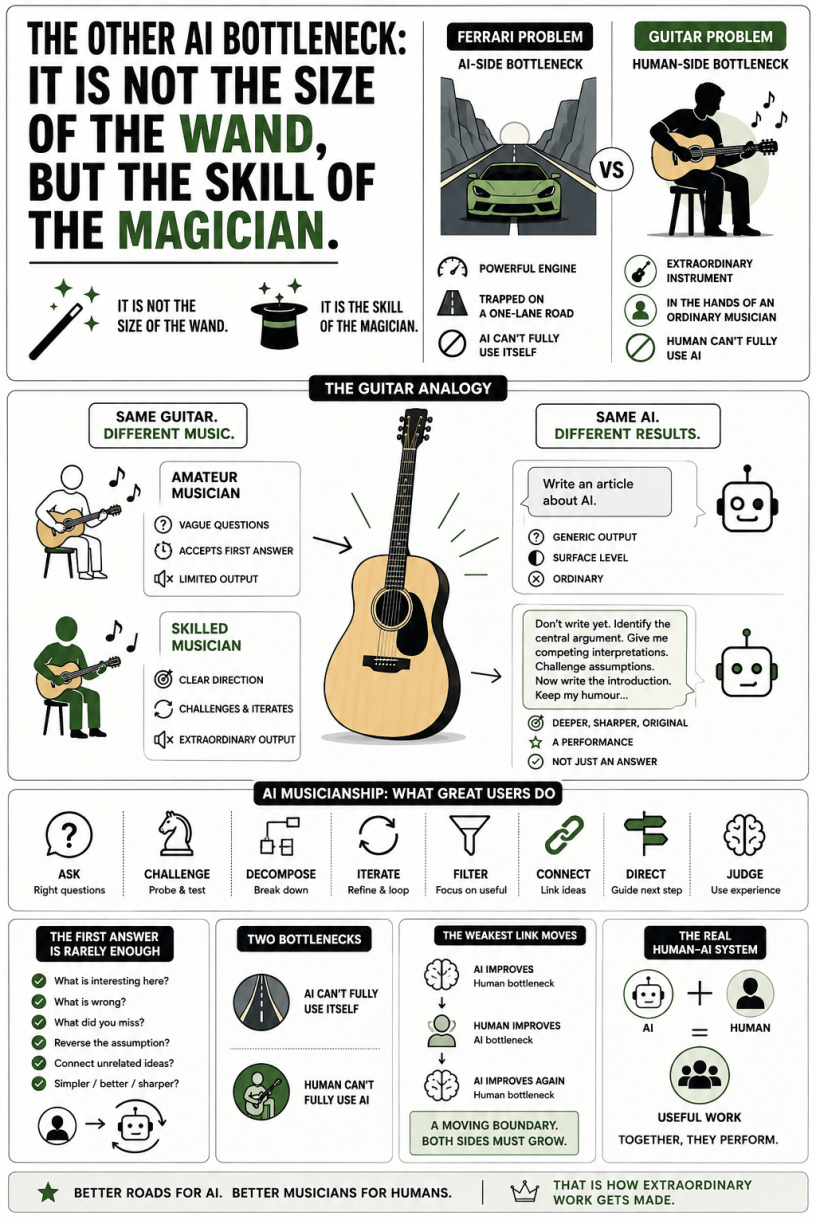
Imagine a Ferrari with a phenomenal engine, but the road on which it has to run has only one lane. You cannot change lanes. You cannot see beyond your immediate lane. There are no proper U-turns. You cannot easily move from one part of the road to another.
The Ferrari is powerful.
The bottleneck is the road.
That was about the AI-side bottleneck.
But there is another, almost opposite problem.
Sometimes the road is perfectly good.
The Ferrari is available.
And still, the journey is ordinary.
Why?
Because the driver is the bottleneck.
The guitar problem
Take a world-class guitar.
Give it to a person who knows only three chords.
The guitar has not become less capable.
But the music that comes out of it will be limited by the person playing it.
Now give exactly the same guitar to a great guitarist.
Suddenly the same instrument can produce something completely different.
Nothing changed in the guitar.
The bottleneck was the musician.
AI is increasingly becoming like that guitar.
We are getting extremely powerful instruments.
But most users are still learning how to play them.
It is not the size of the wand
There is an old idea in magic:
It is not the size of the wand; it is the skill of the magician.
The same idea applies surprisingly well to AI.
People often discuss AI capability as if capability automatically becomes useful output.
A more powerful model should therefore produce better work.
Not necessarily.
A very powerful AI in the hands of a user who asks:
“Write an article about AI.”
will probably produce a reasonably good article.
But another user may start with a completely different approach:
“Don’t write the article yet. First identify the central argument. Give me three competing interpretations. Find the weakest assumption. Challenge my analogy. Now restructure the argument. Keep my original humour and terminology. Don’t make it sound like native corporate English. Now write the introduction. Stop there.”
The second user is not necessarily using a different AI.
He is playing the same instrument differently.
Prompting is only the beginning
This is why I think the term prompt engineering is too narrow.
The real skill is much larger.
A good human-AI operator needs to know when to:
- ask
- challenge
- interrupt
- decompose
- combine
- reject
- compare
- test
- reformulate
- preserve
- simplify
- expand
The important skill is not writing a beautiful prompt.
It is knowing what to do next.
AI can produce ten possibilities in seconds.
The human has to recognise that possibility number seven is interesting, number three is nonsense, number five contains an unexpected insight, and number eight can be combined with something discussed twenty minutes ago.
That is not prompt engineering.
That is AI musicianship.
The first answer is often the least interesting part
One of the biggest mistakes in using AI is treating the first answer as the finished product.
The first answer is often only the beginning of the conversation.
A skilled user does something different.
He looks at the answer and asks:
- What is interesting here?
- What is wrong?
- What did you miss?
- What happens if we reverse the assumption?
- Can these two apparently unrelated ideas be connected?
The AI becomes less like a search engine and more like a thinking instrument.
The conversation itself becomes the workspace.
Human expertise becomes more important, not less
There is another paradox here.
As AI becomes better at producing answers, human judgment can become more important.
If I know very little about a subject, I may not even recognise a wrong answer.
AI can produce something that looks extremely convincing.
But an experienced person can say:
“Wait. That doesn’t fit my observation.”
That single sentence can completely change the direction of the interaction.
The human brings something the AI does not automatically possess:
a reason to care whether the answer is actually useful.
Experience provides the strange observation. Curiosity notices the anomaly. Judgment rejects the attractive but wrong explanation. Intuition sometimes asks the question that nobody else thought of asking.
AI can then do enormous amounts of work on that question.
The amateur may own the Ferrari and still drive slowly
This is where the Ferrari analogy returns.
In the first article, the Ferrari was trapped by its road.
Here the Ferrari may have a perfectly good road.
But imagine giving the keys to someone who has never driven a Ferrari.
He may drive at 40 km/h.
Not because the Ferrari cannot go faster.
Because he does not know how to use it.
This is increasingly becoming the situation with AI.
We sometimes compare models by asking:
Which AI is more intelligent?
But another useful question is:
Which human is able to extract more from the same AI?
That is a very different competition.
Two bottlenecks
This gives us two opposite problems.
Bottleneck 1: AI cannot fully use itself
The AI has enormous internal capability, but its architecture and interface constrain how that capability can be accessed.
Ferrari + one-lane road.
The machine is the bottleneck.
Bottleneck 2: Human cannot fully use AI
The AI is extraordinarily capable, but the human does not know how to direct, interrogate, test and exploit it.
Great guitar + mediocre guitarist.
The human is the bottleneck.
These two problems can exist simultaneously.
And that is perhaps the most important point.
The weakest link moves
Suppose AI becomes ten times more capable.
If the human can exploit only 20% of that capability, much of the improvement remains unused.
Now improve the human’s ability to work with AI.
The human starts extracting much more.
Eventually, however, the human reaches the limits of the AI’s own architecture.
The bottleneck moves back to the AI.
Improve the AI again.
The bottleneck moves back to the human.
And so on.
It becomes a moving boundary.
AI improves → human becomes the bottleneck.
Human improves → AI becomes the bottleneck.
AI improves again → human becomes the bottleneck again.
This is why simply making models larger may not be the complete answer.
And simply teaching people prompt tricks isn’t the complete answer either.
From prompt engineering to AI musicianship
Perhaps the next generation of AI users will be distinguished less by who knows the most prompt formulas and more by who has developed a kind of AI musicianship.
A good AI musician will know how to use the instrument differently for different purposes.
Sometimes the AI should be a researcher.
Sometimes a critic.
Sometimes a brainstorming partner.
Sometimes a calculator.
Sometimes a devil’s advocate.
Sometimes an editor.
Sometimes it should simply be told:
“Stop. You are going in the wrong direction.”
The skill is not merely getting an answer.
The skill is conducting the interaction.
The strange advantage of human imperfection
There is one more thing worth remembering.
AI can generate enormous numbers of possibilities.
But the human’s apparently irrational thought may be exactly what makes the final result interesting.
A strange analogy.
An unusual connection.
A half-formed thought.
A disagreement.
A “this doesn’t feel right.”
A sudden change of direction.
These may look inefficient from the perspective of a machine optimised for producing answers.
But they can be extremely valuable for producing new ideas.
The human does not have to compete with AI at producing more words.
That would be a terrible competition.
The human’s advantage may be in deciding which strange direction is worth pursuing.
The real human-AI system
So perhaps we should stop thinking about AI as a machine that simply gives answers to humans.
The better model is a human-machine system.
The AI supplies enormous computational and generative capability.
The human supplies intention, judgment, experience, curiosity and selection.
Neither side is sufficient by itself.
And both sides can become the bottleneck.
The Ferrari needs a better road.
The guitarist needs to learn to play.
And the magician needs to know what magic he is trying to perform.
The final question
So the next time somebody says:
“This new AI is much more powerful.”
I would ask two questions.
First:
Can the AI actually access and use all that power?
That is the Ferrari problem.
Second:
Can the human actually extract and direct all that power?
That is the guitar problem.
And behind both is the same larger question:
How much of the available intelligence can the human-AI system actually convert into useful work?
Perhaps that is a better measure of AI progress than model size alone.
Because in the end:
It is not the size of the wand. It is the skill of the magician.
And sometimes, of course, the magician may be very skilled—
but somebody has still put the Ferrari on a one-lane road.
 Future Trends | AI | Human Thinking