

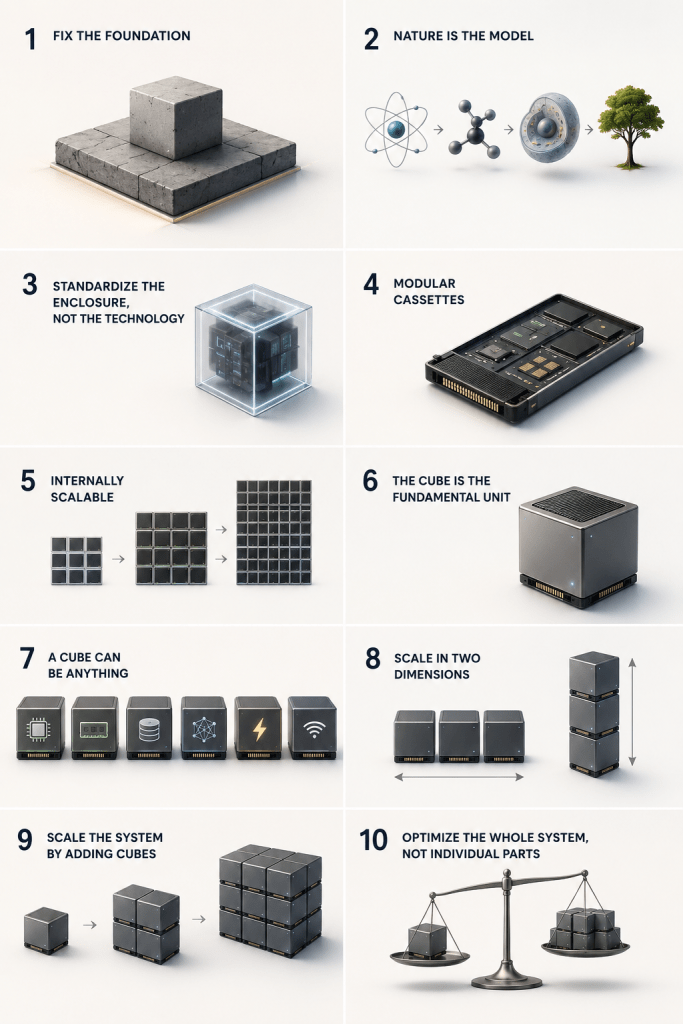
Every few years, computing seems to rebuild itself.
A new CPU arrives. Then a new socket. New RAM. New memory standards. New GPU interfaces. New motherboards. New power requirements. And after a few generations, an otherwise perfectly useful computer becomes difficult to upgrade because its foundation has become obsolete.
Perhaps we are optimizing at the wrong level.
Nature offers a different lesson. The atom has a remarkably stable underlying architecture. We don’t redesign the atom every time we want a better molecule. Chemistry builds upward from a fixed foundation. Molecules build larger structures. Cells build organisms and ecosystems.
The foundation remains stable while complexity evolves above it.
What if computers did the same?
1. Fix the Foundation
The first principle is simple: stop rebuilding the basic physical topology every generation.
We should eventually establish a computing architecture whose fundamental dimensions, interfaces and connections remain stable for decades.
That does not mean freezing technology. Quite the opposite. It means giving technology a stable place to evolve.
Instead of replacing the whole computer because a new generation of memory or processors arrived, we replace the relevant module within a permanent architecture.
The computer becomes a platform for evolution rather than something that itself becomes obsolete.
2. Nature Is the Model
Nature is extraordinarily modular.
Atoms combine into molecules. Molecules form increasingly complex structures. Cells combine into organisms. Organisms form ecosystems.
The important point isn’t that nature is always better or faster. It is that nature operates within stable rules and constraints and builds complexity on top of them.
The periodic table is a wonderful example. Elements have different properties, but elements within a group share important structural characteristics. The underlying rules don’t change every time chemistry becomes more sophisticated.
We don’t invent a new kind of atom for every new material. We use the existing atoms differently.
Computing could adopt the same philosophy:
Standardize the building block; let technology evolve inside it.
3. Standardize the Enclosure, Not the Technology
This is perhaps the most important distinction.
We don’t need to standardize what is inside a module. We need to standardize where it fits and how it connects.
Imagine a room with fixed dimensions and a standardized door. What happens inside the room can change completely.
A computing cassette could work the same way. Its physical dimensions, connection location, power interface, data interface, mechanical attachment and discovery protocol could remain standardized.
Inside it, however, engineers can use whatever technology is available.
Today’s memory. Tomorrow’s 3D memory. Something completely different ten years later.
The enclosure survives; the technology evolves.
4. Modular Cassettes
Think of a cassette as a standardized piece of computing infrastructure.
A RAM cassette could contain memory. An SSD cassette could contain storage. A compute cassette could contain CPUs, GPUs or AI accelerators. Another cassette might contain networking. Another could contain power.
The cassette itself remains compatible with the larger architecture.
This also makes replacement much simpler.
Instead of replacing the entire computer:
Pull out the old cassette. Insert the new one.
The analogy is closer to replacing a memory card than rebuilding a PC.
And the cassette doesn’t have to remain internally fixed either.
5. Make the Cassette Internally Scalable
Suppose a RAM cassette has a fixed external size.
Inside it could initially have a relatively small grid of memory units. As semiconductor technology improves, those units become smaller.
The same physical cassette could eventually contain vastly more cells. The external cassette hasn’t changed. The density has changed.
This gives us two kinds of scaling.
- More cassettes: more capacity.
- Better technology inside the same cassette: more capacity per cassette.
This is where future 3D chip technology becomes particularly interesting. Instead of merely making components smaller in two dimensions, technology can increasingly build vertically.
The cassette becomes a standardized “room” in which increasingly dense technology can be installed.
6. The Cube Is the Fundamental Unit
Now take the idea one level higher.
Make a small standardized computing cube—perhaps roughly three inches, although the actual dimensions would need engineering and industry agreement.
The important thing isn’t three inches. The important thing is: the cube has fixed topology.
- Standard dimensions.
- Standard connection points.
- Standard power.
- Standard communication.
- Standard mechanical interfaces.
Inside the cube, almost anything can exist.
A cube could contain a complete small computer. Or it could be mostly memory, storage, AI acceleration, networking, power, or a combination.
The cube becomes the equivalent of a room in a building.
7. A Cube Can Be Anything
This is where the architecture becomes genuinely flexible.
Imagine five cubes:
- Compute Cube — CPU + GPU/NPU + supporting electronics
- Memory Cube — large amounts of high-speed memory
- Storage Cube — massive SSD capacity
- AI Cube — specialized acceleration
- Network Cube — high-speed networking
All five have the same fundamental physical form and interface.
But they perform completely different jobs.
You could therefore construct one computer cube, one compute cube plus two memory cubes, two compute cubes plus four storage cubes, or ten storage cubes plus two compute cubes.
The physical architecture remains the same. Only the composition changes.
8. Scale in Two Dimensions
Most computers today scale mainly by replacing components with larger ones.
Your architecture allows something different.
Horizontal scaling: add another cassette or another cube.
Vertical scaling: pack increasingly capable technology into the same cassette or cube using denser technology and eventually 3D-stacked chips.
So we get horizontal scaling plus vertical scaling.
The building analogy works again. Need more rooms? Build sideways. Need more floors? Build upward.
The fundamental room remains unchanged.
9. Scale the System by Adding Cubes
This could completely change the idea of buying a computer.
Today we ask: which computer should I buy?
A modular architecture would let us ask: how much computing do I need?
One cube might be enough for a simple personal device. Four cubes could make a more powerful workstation. Dozens could create a server. Hundreds or thousands could form a larger computing installation.
The same basic architecture could exist at every scale.
Even a future smartphone could potentially be built around the same philosophy. Imagine a phone-sized compute cuboid that can communicate with another identical unit. One is a phone; four connected units could become a larger distributed computing system.
10. Optimize the Whole System, Not Individual Parts
This may be the most important design principle of all.
Technology often celebrates the fastest individual component: the fastest CPU, GPU, memory or SSD.
But a system is not a collection of independent benchmarks.
Imagine a cart pulled by four horses. Three horses can run at 100 km/h. One can run at 40 km/h. Making one of the 100 km/h horses faster doesn’t necessarily make the cart faster. The system is constrained by coordination and bottlenecks.
Nature faces the same problem. It cannot optimize every biological component independently. Energy, space, heat, transport, reliability and coordination all matter.
So nature often achieves remarkable results not through one spectacular component, but through system-level balance.
The objective shouldn’t simply be maximum performance per component. It should be:
Maximum useful computing per unit of energy, space, heat, complexity and cost.
The Foundation Should Eventually Stop Moving
This is the central idea behind the entire proposal.
We cannot keep digging the foundation forever.
At some point, an architecture needs to become sufficiently mature that we say:
This is the room. This is the door. This is the interface. Now innovate inside it.
That is what a successful long-lived standard can accomplish.
The standard itself becomes infrastructure.
Technology then evolves inside the infrastructure rather than destroying it.
A RAM technology invented in 2035 doesn’t require a completely different computer architecture. A storage technology invented in 2040 doesn’t require a new physical ecosystem. A radically better AI processor in 2045 can occupy the same standardized compute space.
The machine doesn’t become obsolete. Its contents do.
And replacing contents is much easier than replacing the building.
From PC to Computing Building
The ultimate architecture might therefore look something like this:
Tiny units → Cassettes → Cubes → Cube arrays
Each level has a stable physical topology.
Each level can become denser.
Each level can be replicated.
Each level can be combined.
And each level can evolve independently.
The result is not one enormous unified computer. It is a universal modular computing environment.
One cube → personal computer.
Four cubes → workstation.
Many cubes → server.
Many more → computing infrastructure.
The same rules apply at every scale.
The Bigger Idea
Perhaps the future computer shouldn’t be thought of as a machine.
It should be thought of as a building system.
A machine is something you buy.
A building system is something you configure, expand, repair and evolve.
Your computer should not become useless because one component generation has ended. Your storage shouldn’t have to dictate your compute configuration. Your memory shouldn’t dictate your motherboard. And your entire machine shouldn’t have to be thrown away simply because one technology has improved.
Instead:
Keep the architecture. Replace the contents. Add capacity when needed.
Nature doesn’t redesign the atom every time it wants something new.
Perhaps we shouldn’t redesign the computer every time we invent something new either.
Fix the room. Standardize the door. Then let technology fill the building.
 Future Trends | AI | Human Thinking