
For decades, the modern company has been built around a simple constraint: human beings cannot process everything.
A CEO cannot monitor every customer. A manager cannot watch every operation. An executive cannot analyse every data stream. An employee cannot continuously evaluate every possible decision.
So organizations created layers.
Workers handled tasks. Managers coordinated workers. Executives coordinated managers. The CEO coordinated the whole system.
The corporate hierarchy was, in part, a solution to human cognitive scarcity.
AI changes that equation.
The interesting question is therefore not simply, “How many jobs will AI replace?”
It is:
What happens to an organization when intelligence and decision-making become abundant?
1. The Decision Pyramid
The traditional organization can be understood as a decision pyramid.
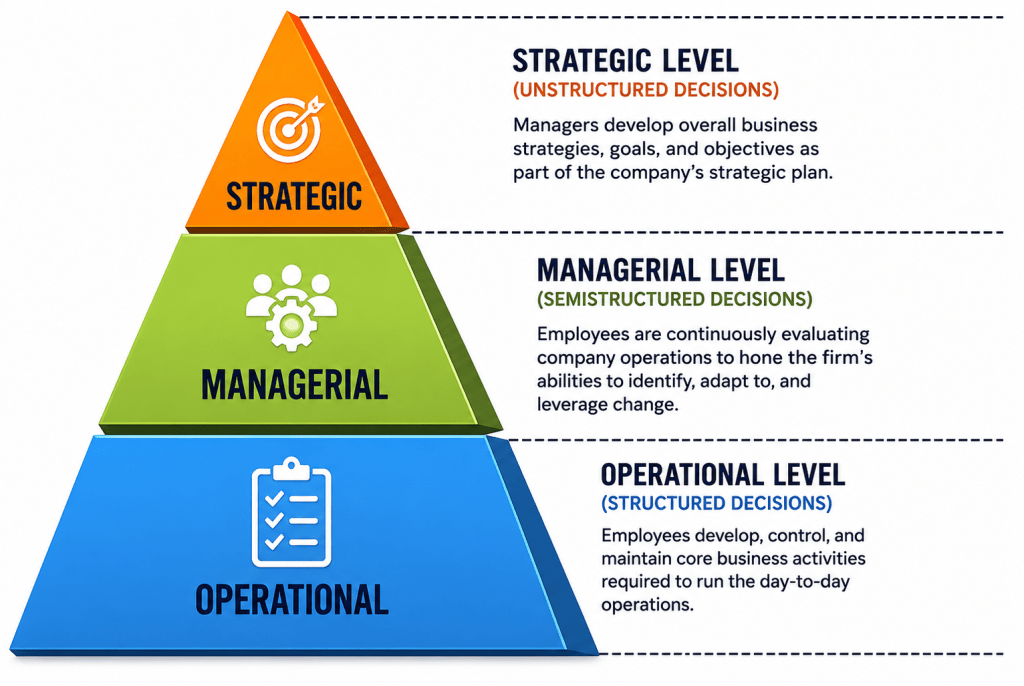
Traditional organizational decision hierarchy: strategic, managerial and operational decisions.
At the bottom are structured operational decisions. They follow rules, procedures and established workflows.
Above them are managerial decisions. These are more ambiguous. Managers interpret information, resolve conflicts and adapt operations.
At the top are strategic decisions. These involve uncertainty, incomplete information, competing objectives and long time horizons.
Historically, each layer existed partly because the layer below could not efficiently coordinate itself.
The result was a pyramid:
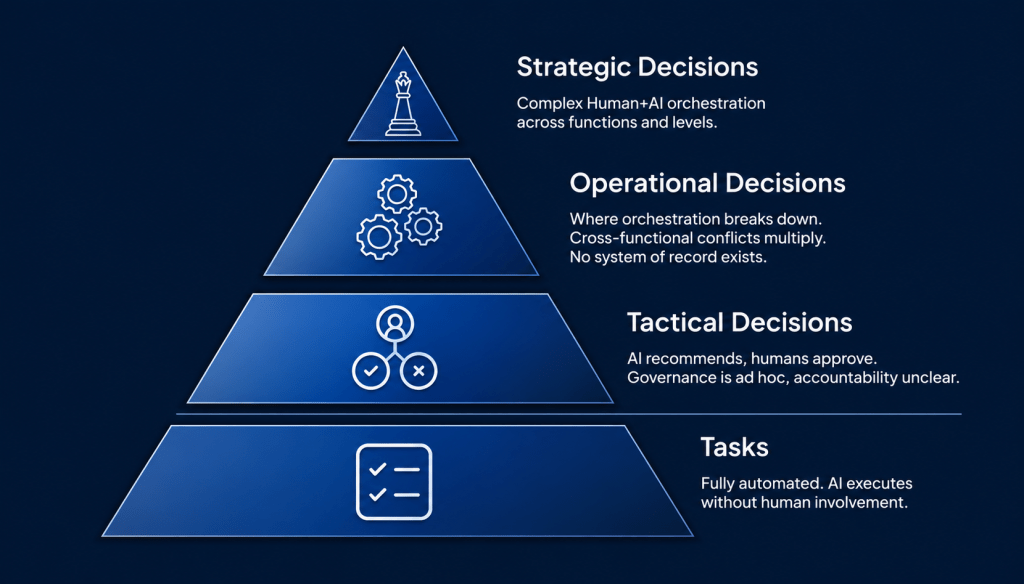
Tasks → Tactical decisions → Operational decisions → Strategic decisions
AI begins attacking this pyramid from the bottom upward.
2. From Tasks to Decisions
The first wave of automation targeted tasks.
A machine could calculate faster than a person. Software could store more information. Robotic systems could repeat physical actions.
AI goes further because many supposedly “human” jobs contain a large amount of decision processing.
Consider a manager. A manager may collect information, compare alternatives, identify anomalies, forecast outcomes, allocate resources, approve actions, monitor results and correct mistakes.
Much of that can be represented as a decision loop:
Observe → Analyse → Decide → Act → Measure → Correct
The more of this loop AI can perform, the less important the traditional management layer becomes.
This produces a possible progression:
- Task automation
- Decision assistance
- Decision automation
- Agentic execution
- Organizational automation
That is a much bigger transition than simply replacing clerical workers.
3. The Middle of the Pyramid Is the Problem
Today’s companies increasingly have AI systems that can make recommendations. But the organization around them was not designed for machine-speed decision-making.
Data sits in different systems. CRM has one view. ERP has another. Analytics has another. Departments have different objectives. Managers reconcile the contradictions.
This creates an unusual situation:
AI may be capable of making a decision while the organization remains incapable of acting on it efficiently.
The bottleneck therefore moves. The problem is no longer simply, “Can we analyse the data?” It becomes, “Can the organization turn intelligence into coordinated action?”
Decision-making workflow: data aggregation → AI analysis → recommendation → human validation → execution → feedback.
This is where AI agents become important.
4. From AI Assistant to AI Agent
A conventional AI assistant waits for a human instruction.
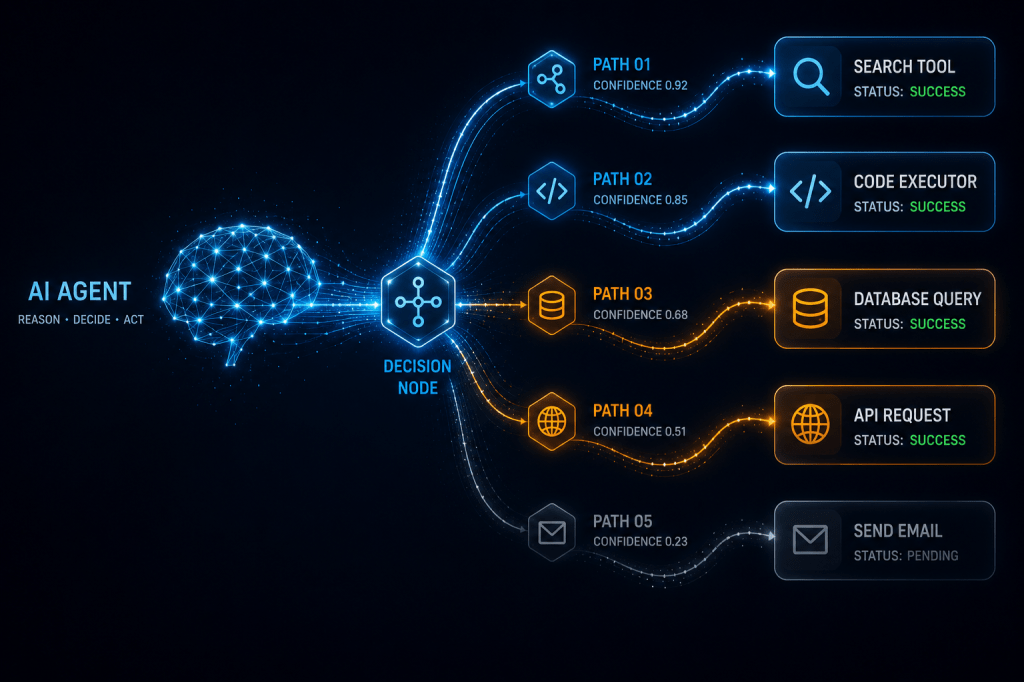
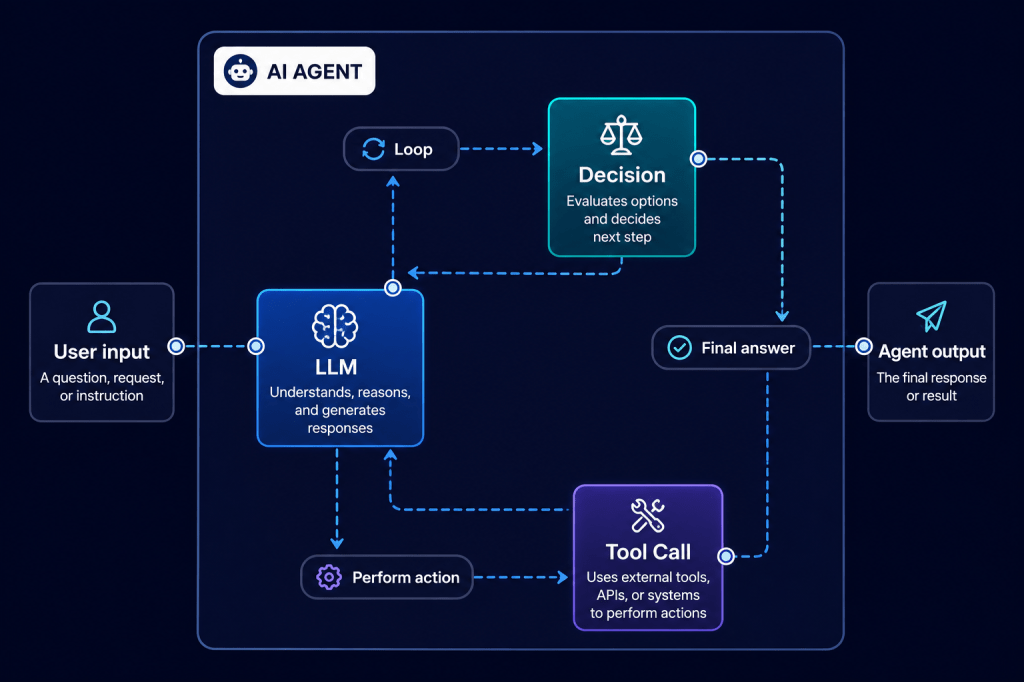
An agent is different. The agent can interpret an objective, analyse available information, decide what to do next, call a tool, observe the result, reconsider the decision and continue until the objective is reached.

An AI agent turns an LLM from a response generator into a decision-and-action loop.
This is a crucial transition.
The LLM is no longer the entire system. It becomes the reasoning component inside a larger loop.
The loop can contain:
LLM → Decision → Tool → Result → LLM → Decision → Tool
That means an AI system can increasingly move from:
“Here is what you should do.”
to:
“I have done it.”
That distinction is enormous.
5. The AI Doesn’t Need Every Tool — It Needs the Ability to Choose
Imagine an AI agent receives a business request. It might need to search the web, query a database, execute code, call an API, send an email, update a CRM, book an appointment or generate a report.
The important capability is not simply possessing all these tools.
It is choosing the correct tool at the correct moment.
An AI agent evaluates possible action paths and selects tools according to the task and available evidence.
This is where the idea of decision nodes becomes powerful.
The system doesn’t merely produce text. It chooses a path.
And once AI can choose paths reliably, entire administrative workflows can disappear behind a single instruction.
Instead of:
Customer → website → search → form → receptionist → manager → confirmation
the customer may simply say:
“Book me an appointment next Tuesday afternoon.”
The AI performs the intermediate work. The customer sees only the outcome.
6. The Collapse of the Managerial Pyramid
Now consider what happens when this capability spreads through an organization.
Tasks become automated first. Then routine decisions. Then exception handling. Then cross-functional coordination. Then increasingly complex operational decisions.
The pyramid begins to compress.
Traditional organization:
CEO → Executives → Managers → Supervisors → Workers
could increasingly become:
Human leadership → AI orchestration layer → small number of high-leverage humans → AI agents + automated systems
The question becomes uncomfortable:
If an AI system can continuously observe the business, analyse alternatives, execute decisions and learn from outcomes, what exactly is the economic function of several layers of management?
7. The CEO Paradox
The CEO is hired to improve the organization.
The CEO deploys AI. AI makes employees more productive. AI automates workflows. AI improves forecasting. AI automates reporting. AI coordinates departments. AI increasingly assists with strategy.
Eventually, the CEO may have helped create a system capable of performing much of the CEO’s own information-processing function.
That creates a strange recursive possibility:
The CEO trains the system that eventually makes the CEO unnecessary.
The economic mechanism does not require anyone to believe that AI should replace CEOs. It only requires one company to demonstrate similar performance with lower management cost and faster decisions.
If that company consistently outperforms competitors, shareholders have a simple question:
“Why aren’t we doing the same?”
8. Not Every Decision Can Be Automated
There is an important boundary.
Not every decision is simply an optimization problem.
Consider three layers:
Computation: “What is the best solution given these objectives?”
AI is increasingly powerful here.
Judgment: “Which objective should we choose when values conflict?”
This is harder.
Legitimacy: “Who has the authority to make this decision over other people?”
That is different again.
This distinction becomes particularly important in government. A bureaucratic decision may be technically optimizable. But a political decision may involve competing values: efficiency versus equality, growth versus environment, security versus privacy, majority preference versus minority protection.
AI can model the consequences. It cannot automatically determine society’s preferred values.
9. The Future May Be Proportional Autonomy
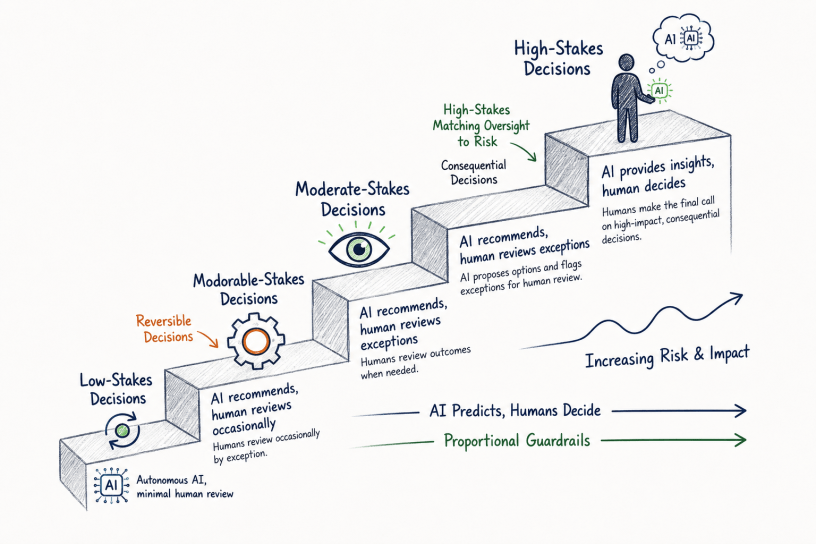
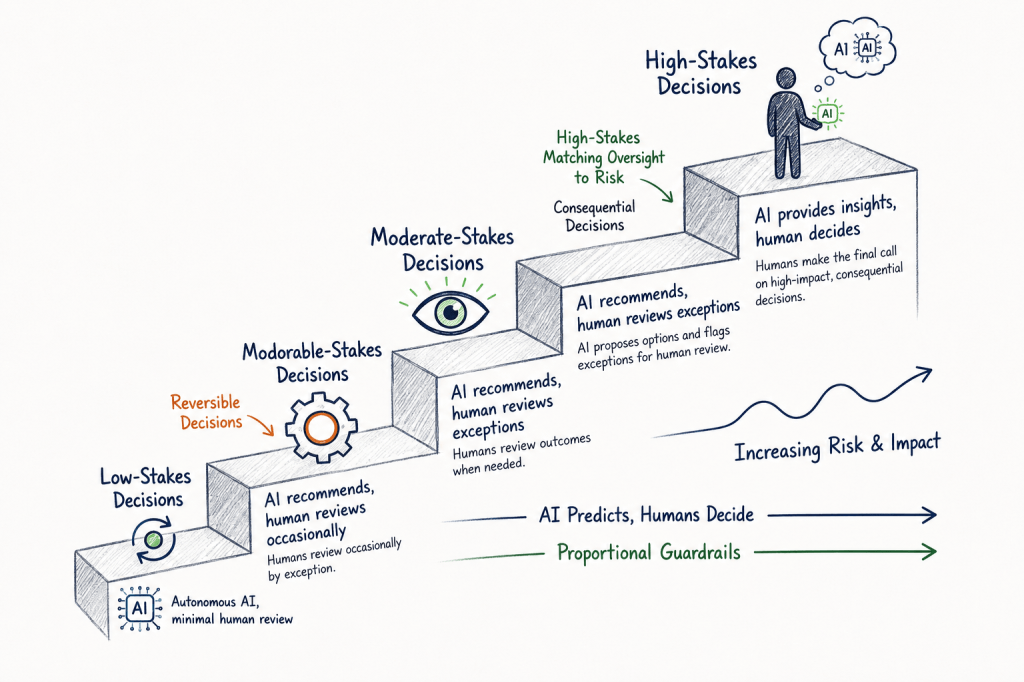
The answer may not be “humans decide everything,” nor “AI decides everything.” Instead, authority could scale with risk.
Proportional autonomy: as decision risk increases, human oversight and governance requirements increase.
Low-stakes, reversible decisions can be almost completely automated.
Moderate decisions can use: AI recommends → human reviews exceptions.
Higher-stakes decisions can use: AI predicts → human decides.
The highest-stakes decisions may require: AI provides analysis → humans retain final authority.
This creates a more useful principle than simply “human in the loop”:
The higher the consequence, the stronger the required governance.
10. The Bigger Economic Question
This transformation connects to a much larger economic paradox.
AI makes intelligence increasingly cheap.
Writing becomes cheap. Coding becomes cheap. Design becomes cheap. Research becomes cheap. Customer service becomes cheap. Analysis becomes cheap. Eventually, even management may become cheaper.
This is the commoditisation of intelligence.
If everyone can rent extremely capable intelligence, then intelligence itself becomes less scarce.
The scarce things move elsewhere:
- Energy
- Compute
- Memory
- Capital
- Physical resources
- Attention
- Trust
- Customers
- Distribution
- Original data
- Human relationships
The economy may therefore shift from “Who has the information?” to “Who controls the scarce resources surrounding intelligence?”
11. The “Rent a Softbrain” Economy
This suggests a new way of thinking about AI.
Instead of buying a separate piece of software for every task, a person or company may increasingly rent intelligence.
Traditional software says:
“Here is a tool. Learn how to operate it.”
AI increasingly says:
“Tell me what you want accomplished.”
That is a profound change.
You don’t necessarily need a separate application for writing, research, coding, customer service, scheduling and analysis. You need an intelligent system capable of using the appropriate tools.
The product is no longer merely software.
The product increasingly becomes capability.
Or, more provocatively:
Rent a softbrain.
12. The Ultimate Organizational Compression
The long-term possibility is therefore not simply: AI replaces workers.
It is:
AI replaces tasks → AI replaces routine decisions → AI replaces coordination → AI compresses management → AI compresses executive functions → AI becomes an organizational operating layer.
At the extreme, the company of the future could be remarkably small.
A handful of humans could define objectives, values, risk tolerance, capital allocation and legal responsibility while AI systems handle much of the continuous observe → decide → act → measure → adapt cycle.
The company becomes less like a pyramid of people and more like a network of intelligent decision loops.
13. The Real AI Disruption
This is why the phrase “AI will replace jobs” may ultimately be too small.
Jobs are bundles of tasks.
Organizations are bundles of decisions.
And management is largely a system for distributing decision-making under conditions of limited human attention and information-processing capacity.
AI attacks that constraint directly.
The deepest disruption may therefore be:
AI doesn’t simply replace the people inside the organization. It may change why the organization needs so many layers of people in the first place.
The first industrial revolution mechanized muscle.
The information revolution mechanized calculation and communication.
The AI revolution may mechanize cognition, coordination and decision-making.
And that leaves us with a remarkable paradox:
The first CEO to successfully automate management may be the CEO who makes the CEO role itself economically obsolete.
The question is no longer simply:
“Will AI take my job?”
It may eventually become:
“Why was this layer of the organization necessary in the first place?”
The Fractal Brain: How AI Can Map the Way Ideas Actually Connect
 Future Trends | AI | Human Thinking