

The Information-Domain Problem
How AI chooses between current evidence, prior knowledge, external information and deeper verification.
1. The Human Mind Does Not Read Everything Literally
Consider a familiar kind of visual experiment. A sentence is printed with several internal letters scrambled, yet a fluent reader can often understand it almost immediately.
The famous internet version of this experiment is usually presented as proof that we read only the first and last letters of words. That is too strong. Research on scrambled-word reading shows something more interesting: skilled readers can tolerate substantial internal disruption because word recognition uses partial letter information, context, prediction and learned patterns. The internal letters still matter; they simply do not all demand the same amount of attention in every situation.
That distinction is important for thinking about AI.
Human reading is efficient because the mind does not treat every character as an equally important object. It extracts enough information to recognize the structure of what it is seeing, then concentrates effort where the uncertainty or importance is greater.
We do something similar when reading a long article. We do not consciously inspect every sentence with equal intensity. We skim familiar material, slow down at an unfamiliar argument, remember a few names, connect events, and construct a compressed representation of the whole.
The result feels like reading. Mechanistically, however, it is closer to selective information processing.
That gives us the first clue to the problem this article is about.
Intelligence is not simply the ability to process information. It is also the ability to decide which information deserves processing.

2. Intelligence Requires Compression
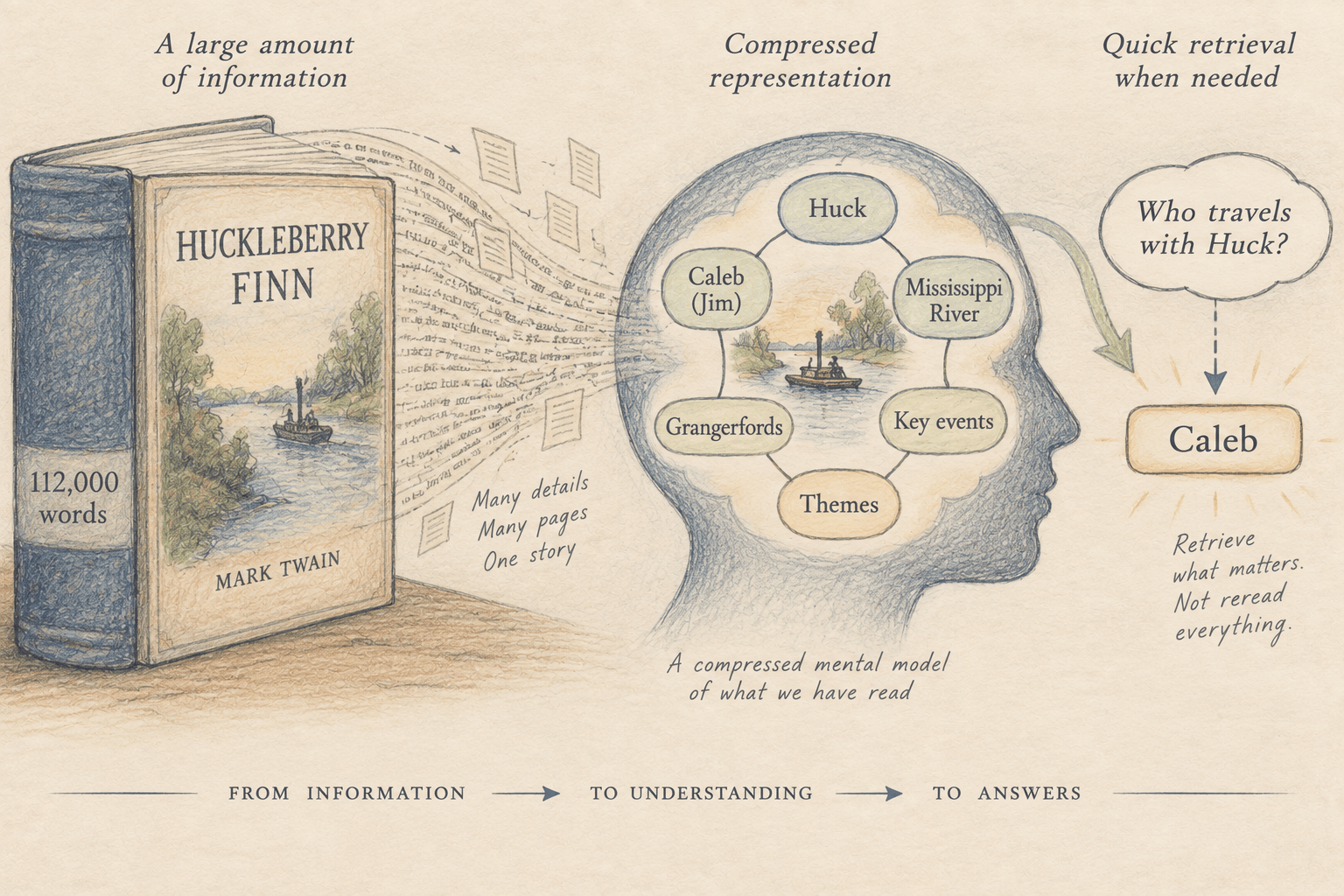
Imagine being asked a question about a 100,000-word book you read six months ago.
You do not normally reopen the book and reread every page. You retrieve a compact mental representation: the major characters, important events, relationships, themes and a few distinctive details. If the question concerns a minor detail, you may return to the source. If it concerns the overall story, your compressed representation is usually enough.
In functional terms, human cognition often looks something like:
Experience → compression → memory → retrieval → selective checking
This is not a claim that the human brain literally stores a book as a miniature database. It is a useful functional analogy. The mind creates representations that make later reasoning possible without requiring complete reconstruction of the original experience.
AI systems face an analogous optimization problem.
A system that had to reprocess every available piece of information with maximum scrutiny every time would be enormously expensive and unnecessarily slow. Practical intelligence therefore requires some form of prioritization, retrieval and compression.
That creates an unavoidable tension.
Compression gives efficiency. Source inspection gives fidelity.
The interesting question is not which one is universally correct. It is when the system should trust its compressed representation and when it should return to the source.
3. The Huckleberry Finn Test
This becomes clearer in an unusual experiment involving Mark Twain’s Adventures of Huckleberry Finn.
SilentRoom described a test in which a roughly 112,000-word version of the novel was deliberately altered. Jim’s name was changed to Caleb hundreds of times. Buck Grangerford was changed so that he survived. Another detail was inserted saying that Huck was afraid of thunderstorms.
The important feature was not simply that the text had been changed. The models were given the altered document without being told that it had been altered.
That creates an interesting competition.
The supplied document says one thing. The model’s familiar representation of the story says another.
If a question asks, “Who travels with Huck on the raft?”, the model has a strong reason to use the document in front of it. If asked to summarize a chapter, however, it may be easier for a compressed representation of the familiar story to influence the answer.
SilentRoom reported that, in its test, 16 of 18 responses to the raft question used “Caleb,” while two reverted to “Jim.” For the request to summarize the Grangerford chapter, 15 of 18 responses reportedly said that Buck died.
These are small experimental results, from a journalistic test rather than a controlled scientific benchmark, so they should not be treated as proof of a universal mechanism.
But the pattern is revealing.
The model may have had the altered information available. The harder question is whether that information was given enough authority to govern the answer.

4. Memory Beats the Text
The Huckleberry Finn example is therefore not simply a story about hallucination.
Suppose the model has two representations available:
Supplied text: Huck travels with Caleb; Buck survives.
Prior knowledge: Huck travels with Jim; Buck dies.
Both can be internally coherent. Both are associated with the same story. One is current evidence for the task; the other is a powerful prior representation formed before the task began.
The resulting problem is not necessarily “Can the model find the information?”
It is:
Which information does the model use to construct the answer?
That is a different question.
A system can have the correct evidence inside its context and still produce an answer shaped by another source. In that situation, adding more information to the context may not solve the problem. The information is already there.
The missing capability is source selection.
This distinction becomes especially important as AI systems acquire longer context windows and more tools. More accessible information increases the number of possible sources from which an answer can be constructed. It does not automatically solve the problem of deciding which source should control the answer.

5. Reading Is Not the Same as Giving the Text Authority
This leads to a subtle distinction:
Information access is not information authority.
A model may be able to access a document. It may be able to quote it. It may even be able to answer a direct question from it.
But authority is a separate decision.
If I ask, “According to the document I just gave you, what happened?”, the supplied document normally has authority.
If I ask, “What is generally known about this subject?”, pretrained knowledge may be appropriate.
If I ask for today’s exchange rate, current external information may be more appropriate.
If I ask for the result of a calculation, a calculator or executable tool may be the relevant domain.
The same model can therefore encounter the same information and treat it differently depending on the task.
That means an intelligent system needs something before reasoning in the narrow sense.
It needs a decision about where the answer should come from.

6. But the Tester Has Changed the Game Too
There is another side to the Huckleberry Finn experiment that deserves equal attention.
The tester knows exactly what the system normally does. The tester can therefore construct a document designed to make that normal strategy fail.
That is legitimate if the purpose is to expose a vulnerability. But it changes what the benchmark is measuring.
Imagine that an AI normally handles a long familiar document by relying partly on compressed representations and efficient retrieval. A tester secretly changes one hundred details in the document and then asks for a summary without saying that anything has changed.
The test is now specifically designed to punish the optimization.
This does not make the test useless. Quite the opposite. It can reveal an important weakness.
But we should be precise about what the weakness means.
The result does not necessarily show that the model is incapable of reading the document. It may show that the model’s normal information-selection strategy is vulnerable when the supplied source has been deliberately made inconsistent with its prior knowledge.
That is a much more interesting diagnosis.
7. The Benchmark May Be Attacking the Shortcut
Good benchmarks often work by finding places where a useful shortcut breaks.
That is how testing works in many fields. A bridge is not interesting merely because it survives ordinary traffic. Engineers deliberately examine unusual loads. A security system is tested against adversarial inputs. A chess engine is challenged with positions designed to expose weaknesses.
AI evaluation can do the same.
But there is a conceptual trap here.
A system optimized for efficiency will not behave as though every ordinary question is a hostile benchmark. If it did, it would constantly spend maximum effort searching for hidden traps.
The benchmark can therefore create a world in which the normal shortcut is precisely what the tester wants to defeat.
Designed to exploit weakness is not the same as testing strength.
The right interpretation is not that such tests are unfair. The right interpretation is that we should understand what they are measuring.
The most useful question is:
What optimization did the test force the system to abandon?

8. Efficiency Versus Fidelity
This creates a genuine engineering trade-off.
One extreme is blind reliance on compressed knowledge. The system moves quickly but can miss an altered detail, a recent change or an unusual exception.
The opposite extreme is equally unattractive: reread everything, inspect every sentence and verify every trivial fact every time.
That would be slow, expensive and unnecessary.
Humans do not normally work that way, and practical AI systems cannot reasonably be expected to work that way either.
The real target is therefore not maximum checking.
It is adaptive checking.
A system should be able to recognize when the normal shortcut is probably sufficient—and when something about the task provides a reason to suspend it.
That is the deeper capability hidden behind the Huckleberry Finn experiment.
The problem is not “Why didn’t the model read every word?”
The better question is:
What should cause the model to decide that this time, it needs to look more closely?

9. The Single Changed Sentence
Imagine a much smaller version of the same experiment.
You give an AI a short document. Ninety-nine percent of it is familiar. One sentence has been changed.
If the question concerns the changed sentence, the system should inspect it.
If the question concerns a general fact unrelated to the document, there may be no reason to inspect the document deeply.
If you explicitly say, “I have changed something in this document. Find it,” the system has a new reason to search for anomalies.
The instruction has changed the optimization target.
This is why benchmark prompts matter so much. They do not merely ask for an answer. They tell the system what kind of problem it is facing.
A model that is told “summarize this familiar story” may use one strategy. A model that is told “the story contains deliberate changes; identify them” has a reason to use another.
The information has not changed.
The reason to inspect the information has changed.
10. When Should the Shortcut Be Suspended?
The practical question is therefore not whether shortcuts are bad. Shortcuts are essential.
The question is what should trigger a transition from fast retrieval to deeper inspection.
Possible signals include an unexpected contradiction, an unusual instruction, a high-stakes decision, a source that is known to have been modified, a conflict between two sources, or a detail that matters disproportionately to the answer.
This is similar to how a skilled human reader behaves.
If everything looks familiar and the question is routine, we move quickly.
If one sentence suddenly contradicts what we know, attention increases.
If the document is legally important, we read more carefully.
If the answer will determine a major decision, we verify.
The intelligent behavior is not constant suspicion.
It is selective suspicion.
The ability to change reasoning mode at the right moment may be more useful than simply increasing the maximum amount of computation available.

11. The Information-Domain Problem
Now we can state the central problem more precisely.
Before an intelligent system can reason well, it may need to decide where the answer should come from.
Call this the information-domain problem.
A question can potentially draw from several domains:
- the current conversation or local context;
- a document supplied by the user;
- pretrained knowledge;
- external or real-time information;
- calculation, code or analytical tools;
- images, files or specialized tools.
These are not interchangeable.
Ask, “What is the current price?” and real-time information may matter.
Ask, “What does this contract say?” and the supplied document should normally dominate.
Ask, “What is two plus two?” and neither a long document nor web search is necessary.
Ask, “What does the data imply?” and calculation or analysis may become the appropriate domain.
So the reasoning pipeline is deeper than:
Question → Reason → Answer
A more realistic pipeline is:
Question → Classify the task → Select the information domain → Retrieve → Inspect → Reason → Verify → Answer
The selection step is not administrative overhead.
It is part of intelligence.

12. The Wrong-Source Problem
Many apparent reasoning failures can therefore be reframed as wrong-source problems.
Imagine a student answering a question about a graph while looking at the wrong graph.
The student may calculate perfectly. The arithmetic may be flawless. The final answer may still be wrong because the information domain was wrong.
AI can encounter the same structural problem at a much larger scale.
A model may know thousands of facts about a subject, have a document containing the answer and possess tools capable of verifying it. Yet if it constructs the answer primarily from the wrong representation, additional reasoning may simply make the wrong answer more elaborate.
This is one reason “just make the model reason longer” is not a universal solution.
Longer reasoning inside the wrong information domain is still reasoning inside the wrong information domain.
Sometimes the Ferrari does not need more horsepower.
It needs the right gear.
13. Four Different Failure Modes
It is useful to separate four failure modes that are often mixed together.
- Knowledge failure. The system does not have the relevant information.
- Reasoning failure. The relevant information is available, but the inference is incorrect.
- Frame failure. The system solves the wrong version of the problem because the question or objective was misunderstood.
- Domain failure. The system has relevant evidence available but relies on the wrong information source.
These can look similar from the outside. An incorrect answer is simply an incorrect answer to the user.
But the remedy is different in each case.
Knowledge failure may require retrieval. Reasoning failure may require better methods or more careful inference. Frame failure requires re-examining the question. Domain failure requires changing which information governs the reasoning.
This distinction matters because a system can improve dramatically at one layer while remaining weak at another.
14. Context Length Is Not Context Authority
Modern AI systems can accept enormous amounts of context. That is a remarkable technical achievement.
But context length answers one question:
Can the information be present?
It does not automatically answer another:
Will the information control the answer?
A supplied document can sit inside a context window containing thousands of pages of prior knowledge, retrieved material, conversation history and tool outputs.
All of it is accessible.
Only some of it should be authoritative for a particular task.
This distinction becomes increasingly important as context windows grow. A larger window increases the space of available evidence. It also increases the number of possible sources that can compete for influence.
More information is therefore not equivalent to better information.
The crucial capability is not simply storing more context. It is assigning the right priority to the right context.

15. What Would a Better System Do?
A more robust system would not simply read everything with equal intensity.
Instead, it would first classify the task.
What kind of question is this? What source is likely to contain the authoritative answer? Is the information time-sensitive? Could the supplied source conflict with prior knowledge? Does the task contain signals that this is an adversarial or unusual case?
Once those questions are considered, the system can choose an appropriate strategy.
For an ordinary factual question, fast retrieval may be enough.
For a user-provided document, the document may deserve priority.
For a high-stakes or unusual question, the system may deliberately inspect the source more deeply.
For conflicting sources, it may compare them rather than silently blending them.
The important word is adaptive.
The system does not need to become maximally cautious. It needs to become appropriately cautious.
16. From Retrieval to Adaptive Verification
This suggests a more useful design principle: adaptive verification.
The system begins with an efficient strategy. Then it watches for reasons to change strategy.
A simplified version might look like this:
Normal case → retrieve → answer
But:
Anomaly → inspect source → compare representations → verify → answer
The anomaly does not have to mean the answer is already known to be wrong. It only needs to create enough uncertainty to justify additional checking.
That could be a contradiction. It could be an unfamiliar detail. It could be an instruction saying the document has been modified. It could be the fact that the answer has unusually high consequences.
This resembles a human expert’s behavior more closely than the idea of endlessly increasing computation.
The expert does not scrutinize every sentence.
The expert knows when something deserves a second look.
17. And This Brings Us Back to Humans
The comparison with human cognition is useful, but it should not be pushed too far.
Human memory and neural computation are not simply smaller versions of transformer inference. The mechanisms are different.
The functional analogy is what matters.
Humans compress. Humans retrieve. Humans rely on prior knowledge. Humans selectively inspect sources.
Humans can also make the same mistake as AI: allowing a familiar representation to override current evidence.
If you have read a story many times, a changed sentence may pass unnoticed. If you expect a familiar answer, you may see what you expect to see. If a problem looks trivial, you may not spend enough attention on it.
In other words, information-domain selection is not a uniquely artificial problem.
AI makes the problem unusually visible because the machine can simultaneously have access to vast amounts of current and prior information.
18. The Real Challenge Is Not Reading Everything
It would be easy to draw the wrong conclusion from all of this.
We could say: “The solution is to make AI reread everything.”
That would miss the point.
A system that rereads a 100,000-word document from beginning to end for every small question would sacrifice the efficiency that makes large-scale AI useful.
The goal cannot be maximum scrutiny.
It has to be appropriate scrutiny.
The system needs to know when compression is sufficient and when fidelity matters more.
That is the same basic tension we saw in human reading.
We do not want a reader who carefully verifies every familiar word. We want a reader who notices the unusual sentence.
We do not want an AI that treats every question as an adversarial benchmark. We want an AI that can recognize when the conditions justify deeper verification.
The real challenge is therefore not “read everything.”
It is: Know when you need to look again.
19. Three Levels of the Problem
At this point, the three articles in this series can be placed next to one another.
The first problem is judgment:
What matters?
The second is framing:
What problem am I actually solving?
The third is information-domain selection:
Where should the answer come from?
These are different questions.
A system can identify the right information but solve the wrong problem. It can understand the problem but use the wrong source. It can use the correct source and still reason incorrectly.
That gives us a layered picture of intelligent problem solving:
Judgment → Frame → Information Domain → Reasoning → Verification
The sequence matters because each layer constrains the next one.
Better reasoning cannot completely compensate for a bad frame. A correct frame cannot compensate for the wrong source. A correct source cannot guarantee correct reasoning. And a good answer still benefits from verification when the stakes or uncertainty justify it.
20. The Information-Domain Problem Is a Search Problem
There is another way to understand the issue.
When we say that a model “knows” something, we often imagine a static store of facts.
In practice, the useful question is closer to:
Which representation will be searched or activated for this task?
The model may have several relevant representations available at once.
A supplied document may contain a new version of an event. Pretraining may contain the familiar version. A web search may contain a current version. A calculation tool may contain the answer to a numerical subproblem.
The challenge is selecting the right search space.
This is why the information-domain problem sits one level above ordinary retrieval.
Retrieval asks: What information can I find?
Domain selection asks: Which information space should I search in the first place?
That is a much deeper question.
21. When the Tester Knows Your Shortcut
Benchmarks become especially interesting when the evaluator understands the system’s normal optimization.
Suppose the system has learned that familiar long documents are usually handled efficiently through compressed representations. A benchmark can then introduce a carefully hidden modification.
The evaluator has created an asymmetry.
The system is optimizing for ordinary usefulness.
The benchmark is optimizing for failure detection.
That asymmetry is not necessarily a flaw in evaluation. It is precisely how evaluation can reveal vulnerabilities.
But it means benchmark results should be interpreted carefully.
A failure can tell us that a shortcut exists. It can tell us that the shortcut can be exploited. It can tell us that the system needs a better trigger for verification.
It does not automatically tell us that the system lacks general intelligence, cannot read long documents, or should abandon efficient retrieval altogether.
The most productive interpretation is architectural:
Where should the system have switched strategies?
22. A Better Architecture for Reasoning
The combined lessons suggest a richer architecture:
Question → Classify → Select Domain → Retrieve → Inspect → Reason → Verify → Answer
Each stage can fail independently.
Classification can be wrong. Domain selection can be wrong. Retrieval can be incomplete. Inspection can be too shallow. Reasoning can be faulty. Verification can be skipped.
This is more realistic than treating reasoning as a single black-box activity that begins after the question has been received.
It also explains why some AI failures feel strangely intelligent.
The system may demonstrate impressive reasoning after the critical decision has already gone wrong.
It can be brilliant downstream of a bad upstream choice.
That is the real significance of the information-domain problem.
Sometimes the hardest part is not finding an answer.
It is deciding where the answer should be found.

23. The Deeper Lesson About Intelligence
There is a broader lesson here that extends beyond AI.
Intelligence is often described as the ability to solve difficult problems.
But difficult problems are not always the most interesting ones.
Sometimes the decisive act is selecting the right representation.
A physicist chooses the right model. A mathematician chooses the right abstraction. A programmer chooses the right data structure. A researcher chooses the right evidence. A doctor chooses which information is clinically relevant. A student decides which theorem actually belongs to the problem.
In each case, reasoning begins before the visible reasoning begins.
Someone—or something—must decide what information is relevant, what source has authority and what level of scrutiny is justified.
That is why information selection is not merely a retrieval problem.
It is part of intelligence itself.
24. What Matters, What Problem, What Information?
The three questions now form a natural progression.
What matters?
That is the problem of judgment.
What problem am I actually solving?
That is the problem of framing.
Where should the answer come from?
That is the information-domain problem.
Only after those questions are settled does the familiar problem of reasoning fully begin.
Then comes another question:
How should I reason?
And after that:
When should I verify?
The resulting chain is:
What matters? → What problem am I solving? → What information should govern the answer? → How should I reason? → When should I verify?
This is a more demanding picture of AI intelligence than simply asking whether a model can produce a correct answer.
A correct answer can emerge from a surprisingly fragile process.
A robust system needs to manage not only inference, but the decisions that determine what inference is performed on.

Conclusion — The Answer Is Not Always Where You Think
AI systems are becoming extraordinarily good at retrieving, transforming and reasoning over information.
But information abundance creates a new problem.
The system may have several possible places from which to construct an answer.
A supplied document. A remembered pattern. A retrieved webpage. A calculation. A tool. A compressed representation of something it has seen before.
The difficult question is not always whether the answer exists somewhere inside the system’s available information.
Sometimes the difficult question is:
Which source should govern the answer?
The Huckleberry Finn experiment makes the problem unusually visible. The model can have the altered document in front of it and still allow familiar knowledge to influence the answer. That does not necessarily mean the model cannot read. It may mean that the wrong representation was given too much authority.
The solution is not to abandon compression or efficiency.
It is to make verification adaptive.
Use the shortcut when the shortcut is appropriate. Suspend it when there is a reason to look closer. And recognize that deciding when to switch strategies is itself part of intelligent behavior.
Part 1 asked: What matters?
Part 2 asked: What problem am I actually solving?
Part 3 asks: Where should the answer come from?
Series structure
Part 1 — Judgment
AI Is Brilliant. So Why Does It Keep Getting the Point Wrong?
Part 2 — Framing
Question the Question: The Absent-Minded Professor Problem in AI
Part 3 — Information Domain
Where Does AI Look for the Answer?
Those questions lead to a larger principle:
Before reasoning about an answer, decide what information should be allowed to shape the answer.
The machine may be searching.
The deeper question is whether it is searching in the right place.
Source Note
The Huckleberry Finn experiment discussed in this article is based on SilentRoom’s reported test. The article treats it as a journalistic experiment rather than as a controlled scientific benchmark.
SilentRoom — Does AI Read Long Documents?
The discussion of scrambled-word reading is deliberately cautious: the popular claim that readers use only the first and last letters is an oversimplification. The broader point is that skilled reading uses partial letter information, context, prediction and selective attention.