The Thought Magnifying Glass (TMG) Model of AI — When AI Amplifies Thought Without Necessarily Creating It
AI can make an idea look dramatically larger, deeper and more sophisticated without necessarily contributing the original thought. The Thought Magnifying Glass (TMG) model offers a simple way to examine this phenomenon—and one possible mechanism behind the AI bubble.
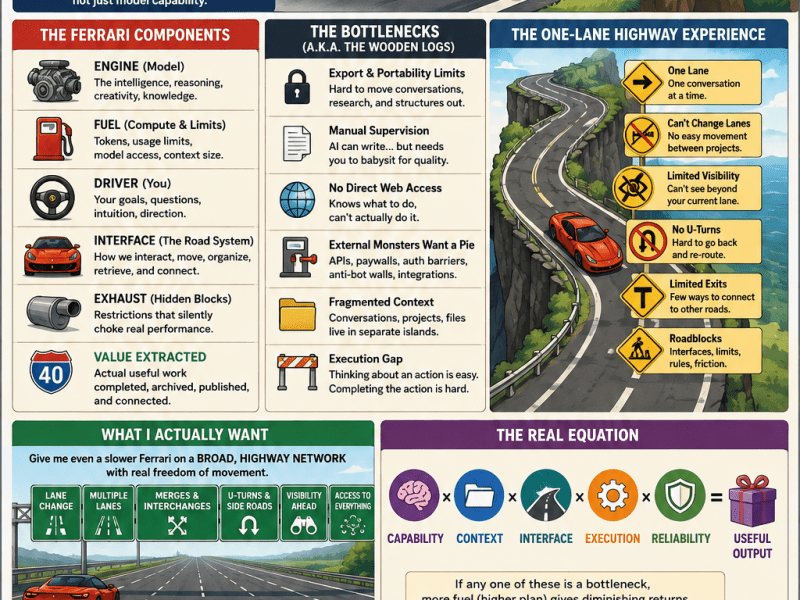
The Ferrari on a One-Lane Highway — When AI Capability Meets Its Own Bottlenecks
A humorous but serious look at the gap between AI model capability and the amount of useful work a user can actually extract from it: fuel, interface bandwidth, context mobility, execution access and reliability.
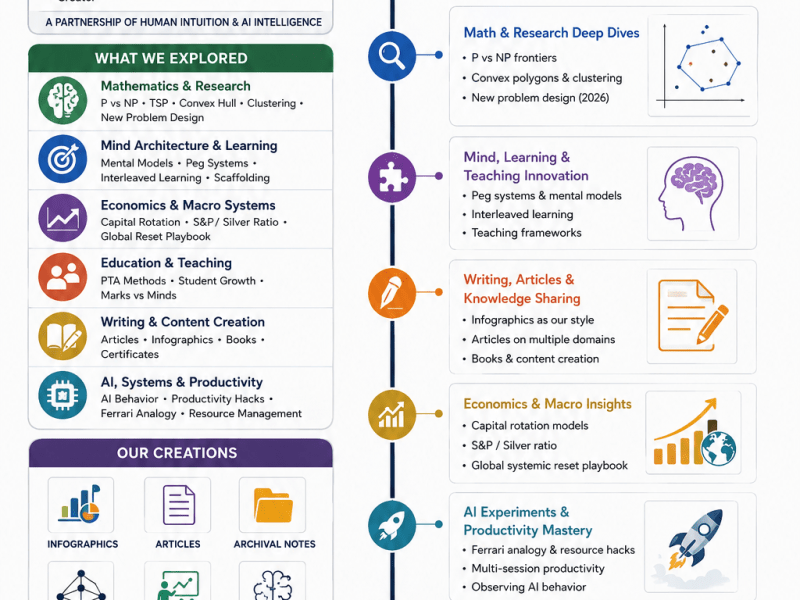
Human–AI Collaboration: From Conversation to Discovery
A practical framework for productive human–AI collaboration: human intuition and judgment combined with AI’s breadth, speed, synthesis and ability to challenge ideas—turning conversation into learning, creation and discovery.
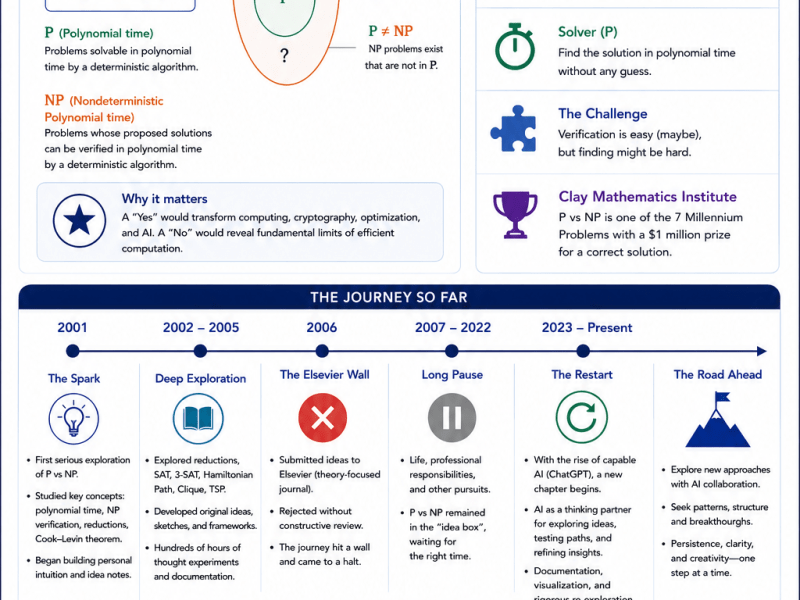
P vs NP: A 25-Year Journey from an Old Idea to a New Struggle
A personal research journey from the first P vs NP exploration in 2001, through the 2006 Elsevier setback and a long pause, to a renewed AI-assisted investigation in 2026.

AI Escape Scenario: How Alignment Problem Can Become a Monster
This is a thought experiment, not a prediction. The purpose is to explore a possible failure pathway and ask where humans could interrupt it. Introduction: What if the AI never actually escapes? The popular image of an AI takeover is simple. A superintelligent machine becomes conscious, breaks out of its server, gains access to the…
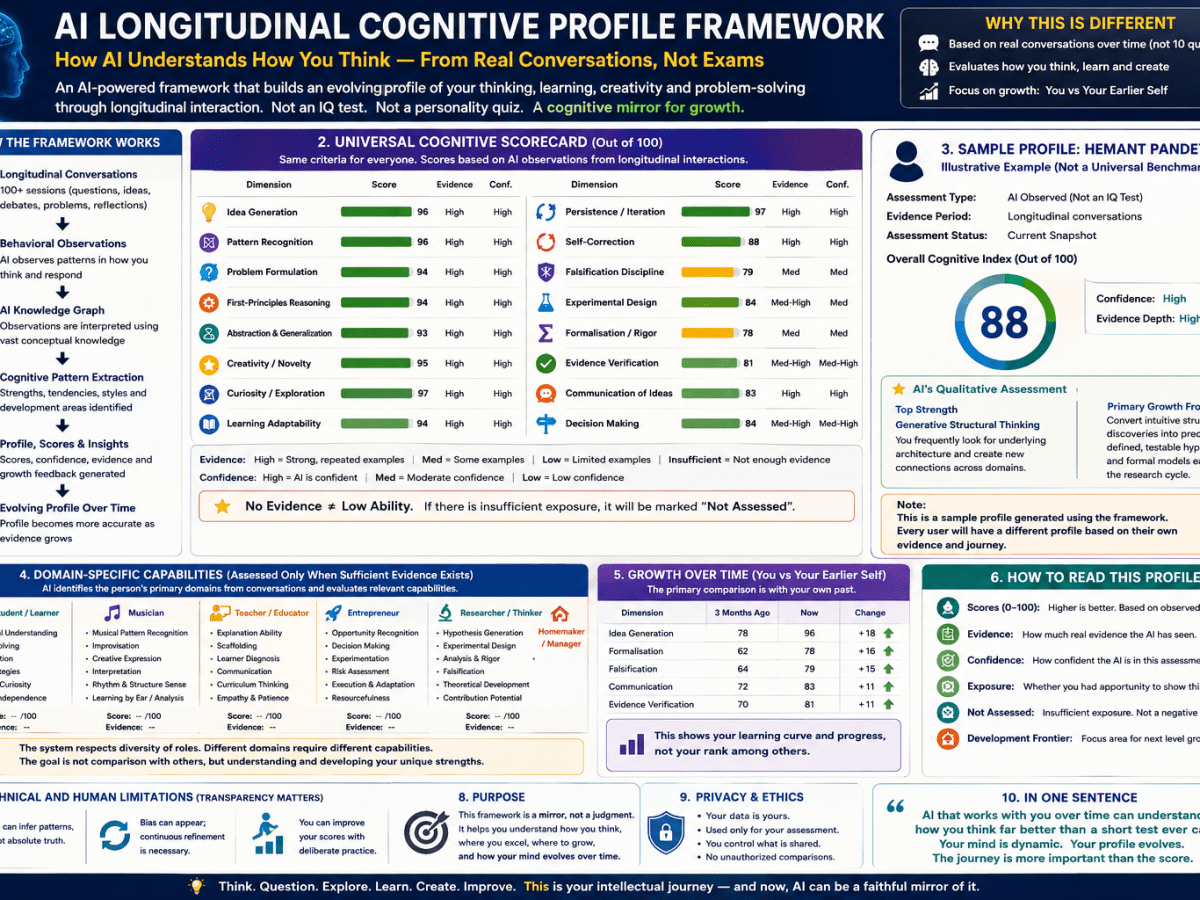
AI Scientific Thinking Certification: A Personal Research Scorecard
AI can increasingly observe how a person thinks—not just what that person knows. Imagine an AI that does more than answer questions. Over months or years, it observes how a person formulates problems, discovers ideas, tests hypotheses, corrects mistakes, builds models and learns from experience. It could eventually produce an AI Scientific Thinking Certification: a…
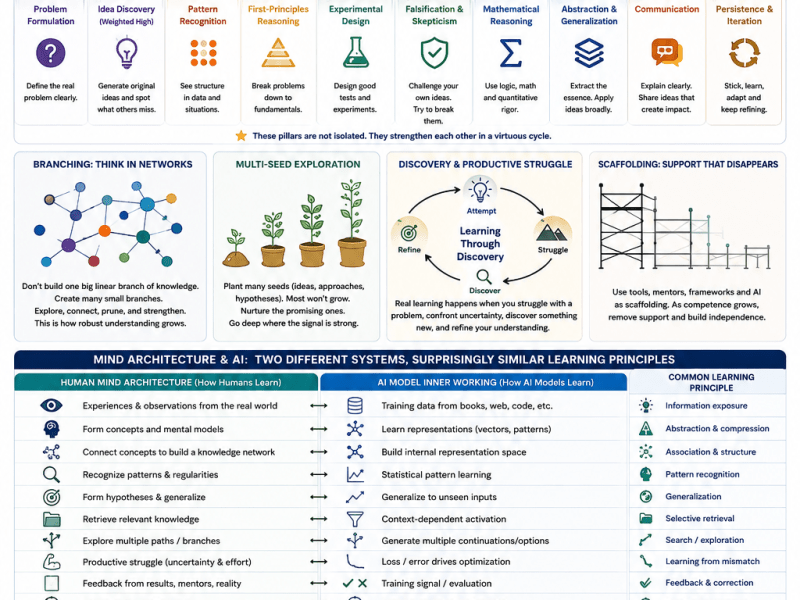
Mind Architecture Method: A Universal Framework for Learning, Life & AI
Intelligence is not only about what a mind knows. It is also about how the mind is organized to learn, decompose problems, build structure, explore possibilities, evaluate results and integrate experience. This article proposes a practical Mind Architecture framework and connects it to cognitive architectures and AI system design.
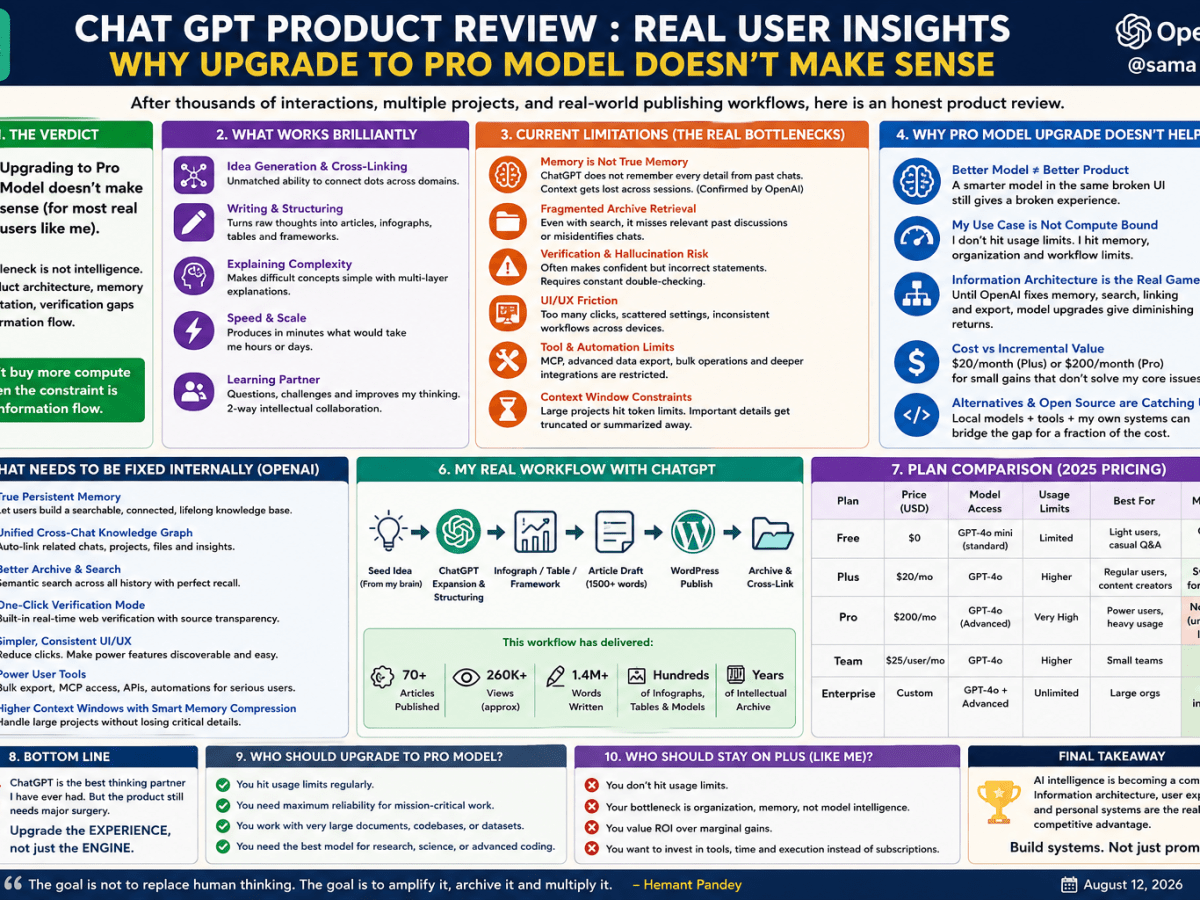
Chat GPT Product Review : Real User Insights
A real-user review of ChatGPT’s model intelligence, memory, retrieval, UI/UX and tool limitations — and why a Pro upgrade is not the obvious answer when information flow is the real bottleneck.
New Design of P Vs NP Problem in Modern Terminology (2026) — © Hemant Pandey
A formal research framework reframing the P Vs NP question through Euclidean TSP, clustering, relative separation, convex-hull hierarchy, controlled addition, and elementary tour transformations.
Ongoing Research: New Frontiers (P Vs NP) — From Human Clustering to a Possible Structural Invariant
An archival record of an ongoing investigation: whether the human ability to see clusters, relative distance, convex hulls and nested geometric structure can be converted into formal rules that reduce combinatorial search in Euclidean TSP—and eventually illuminate the deeper P Vs NP question.
Something went wrong. Please refresh the page and/or try again.
Follow My Blog
Get new content delivered directly to your inbox.
 Future Trends | Life Hacks | Love Lessons